A python library for time-series smoothing and outlier detection in a vectorized way.
- 去噪
- 异常值剔除
- 保留原始数据中存在的时间模式
tsmoothie 平滑
平滑技术
tsmoothie 使用的平滑技术:
- Exponential Smoothing(指数平滑)
- Convolutional Smoothing(卷积平滑)
- constant: window types
- hanning: window types
- hamming: window types
- bartlett: window types
- blackman: window types
- Spectral Smoothing with Fourier Transform(傅里叶变换的频谱平滑)
- Polynomial Smoothing(多项式平滑)
- Spline Smoothing(样条平滑)
- linear
- cubic
- natural
- cubic
- Gaussian Smoothing(高斯平滑)
- Binner Smoothing(分箱平滑)
- LOWESS(局部加权回归散点平滑法)
- Seasonal Decompose Smoothing(季节性分解)
- convolution
- lowess
- natural
- cubic
- spline
- Kalman Smoothing(卡尔曼平滑) with customizable components
- level
- trend
- seasonality
- long seasonality
指数平滑
LOWESS
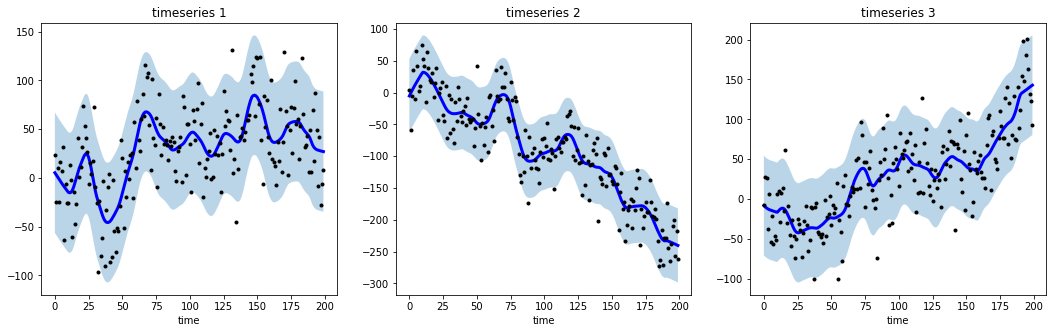
二维变量之间的关系研究是很多统计方法的基础,例如回归分析通常会从一元回归讲起,然后再扩展到多元情况。 局部加权回归散点平滑法(locally weighted scatterplot smoothing,LOWESS 或 LOESS)是查看二维变量之间关系的一种有力工具。
LOWESS 主要思想是取一定比例的局部数据,在这部分子集中拟合多项式回归曲线, 这样便可以观察到数据在局部展现出来的规律和趋势; 而通常的回归分析往往是根据全体数据建模,这样可以描述整体趋势, 但现实生活中规律不总是(或者很少是)教科书上告诉的一条直线。 将局部范围从左往右依次推进,最终一条连续的曲线就被计算出来了。 显然,曲线的平滑程度与选取数据比例有关:比例越少, 拟合越不平滑(因为过于看重局部性质),反之越平滑
区间计算
tsmoothie 提供了作为平滑过程结果的区间计算,这对于识别时间序列中的异常值非常有用。 区间类型有:
- sigma interval
- confidence interval
- predictions interval
- kalman interval
tsmoothie 可以进行滑动平滑的方法来模拟在线使用。
这可以将时间序列分成大小相等的部分并独立平滑它们。
与往常一样,此功能通过 WindowWrapper 类以矢量化方式实现
Bootstrap 算法
tsmoothie 可以通过 BootstrappingWrapper 类操作时序引导,用到的 Bootstrap 算法有:
- none overlapping block bootstrap
- moving block bootstrap
- circular block bootstrap
- stationary bootstrap
tsmoothie 安装
$ pip install tsmoothie
tsmoothie 使用
tsmoothie 平滑 demo
随机游走数据平滑
import numpy as np
import matplotlib.pyplot as plt
from tsmoothie.utils_func import sim_randomwalk
from tsmoothie.smoother import LowessSmoother

# ------------------------------
# generate 3 randomwalks of length 200
# ------------------------------
np.random.seed(123)
data = sim_randomwalk(
    n_series = 3,
    timesteps = 200,
    process_noise = 10,
    measure_noise = 30,
)

# ------------------------------
# Smoothing
# ------------------------------
# operate smoothing
smoother = LowessSmoother(smooth_fraction = 0.1, iterations = 1)
smoother.smooth(data)
# generate intervals
low, up = smoother.get_intervals("prediction_interval")

# ------------------------------
# plot the smoothed timeseries with intervals
# ------------------------------
plt.figure(figsize = (18, 5))
for i in range(3):
    plt.subplot(1, 3, i + 1)
    plt.plot(smoother.smooth_data[i], linewidth = 3, color = "blue")
    plt.plot(smoother.data[i], ".k")
    plt.title(f"timeseries {i + 1}")
    plt.xlabel("time")
    plt.fill_between(
        range(len(smoother.data[i])),
        low[i],
        up[i],
        alpha = 0.3,
    )
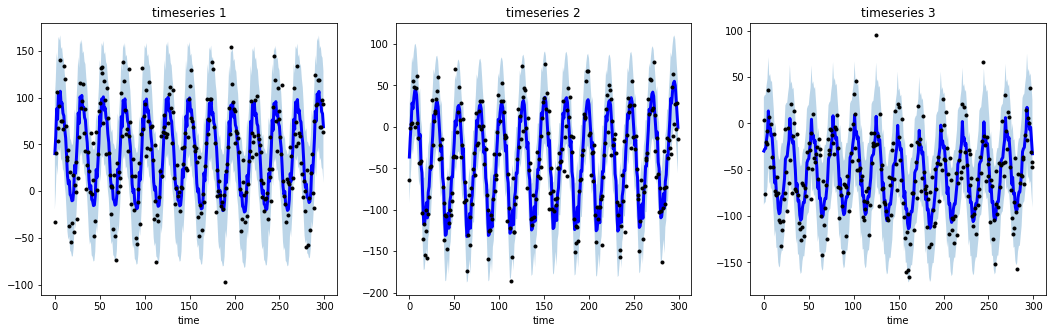
季节性数据平滑
# import libraries
import numpy as np
import matplotlib.pyplot as plt
from tsmoothie.utils_func import sim_seasonal_data
from tsmoothie.smoother import DecomposeSmoother

# ------------------------------
# generate 3 periodic timeseries of lenght 300
# ------------------------------
np.random.seed(123)
data = sim_seasonal_data(
    n_series = 3,
    timesteps = 300,
    freq = 24,
    measure_noise = 30
)

# ------------------------------
# Smoothing
# ------------------------------
# operate smoothing
smoother = DecomposeSmoother(
    smooth_type = 'lowess',
    periods = 24,
    smooth_fraction = 0.3
)
smoother.smooth(data)
# generate intervals
low, up = smoother.get_intervals('sigma_interval')

# ------------------------------
# plot the smoothed timeseries with intervals
# ------------------------------
plt.figure(figsize = (18, 5))
for i in range(3):
    plt.subplot(1, 3, i + 1)
    plt.plot(smoother.smooth_data[i], linewidth = 3, color = 'blue')
    plt.plot(smoother.data[i], '.k')
    plt.title(f"timeseries {i+1}")
    plt.xlabel('time')
    plt.fill_between(
        range(len(smoother.data[i])),
        low[i],
        up[i],
        alpha = 0.3
    )
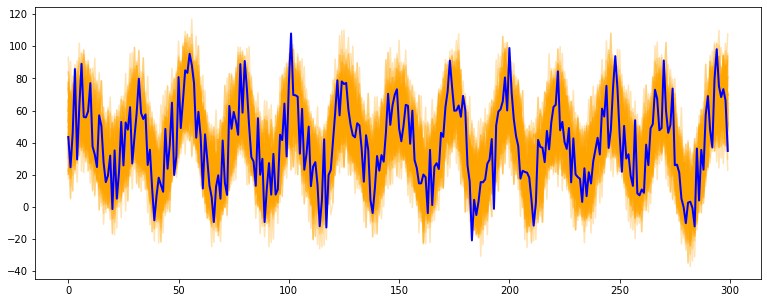
tsmoothie Bootstrap demo
# import libraries
import numpy as np
import matplotlib.pyplot as plt
from tsmoothie.utils_func import sim_seasonal_data
from tsmoothie.smoother import ConvolutionSmoother
from tsmoothie.bootstrap import BootstrappingWrapper

# ------------------------------
# generate a periodic timeseries of lenght 300
# ------------------------------
np.random.seed(123)
data = sim_seasonal_data(
    n_series = 1,
    timesteps = 300,
    freq = 24,
    measure_noise = 15
)

# ------------------------------
# operate bootstrap
# ------------------------------
bts = BootstrappingWrapper(
    ConvolutionSmoother(
        window_len = 8,
        window_type = 'ones'
    ),
    bootstrap_type = 'mbb',
    block_length = 24
)
bts_samples = bts.sample(data, n_samples = 100)

# ------------------------------
# plot the bootstrapped timeseries
# ------------------------------
plt.figure(figsize = (13, 5))
plt.plot(bts_samples.T, alpha = 0.3, c = 'orange')
plt.plot(data[0], c = 'blue', linewidth = 2)
时间序列平滑以更好地聚类
时间序列平滑以更好地预测
降低传感器中的噪声以更好地预测太阳能电池板的发电量
时间序列数据
- 房子每天的煤气消耗量,
$m^{3}$ - 房子每天的用电量,
$kWh$- 负值表示太阳能超出了房子的用电量
- 直流转交流转换器上功率计的日值。这是当前累积的太阳能发电量。 不需要累积值,而是需要绝对的每日值,因此,进行简单的微分操作。 这是预测的目标
时间序列数据平滑
Kalman Filter